
Super Seniors
Exercise equipment that will make you feel like a world class athlete
One thousand one, one thousand two. Click.
Two seconds. Two seconds between Usain Bolt, the world record holder in the 100-meter dash, and Ronald Taylor, the world record holder for men over 60. If that doesn't blow your mind, then fathom this: the world record holder for men over 70, Bobby Whilden, would have finished in this hypothetical race a mere second behind Taylor.
A long time ago, the four-minute mile was considered impossible until young, skinny Roger Bannister eclipsed the mark in 1954. He was 25 at the time. In 2011, 62-year-old Nolan Shaheed ran the 1500-meter (the rough equivalent of a mile) in 4:24.
For women over 60, it's more of the same — astounding times and amazing records. For example, the fastest senior woman alive is Canada's Karla Del Grande, who ran the 100-meter dash in 13.63 seconds in 2014. Compare that to the overall female record holder in the 100, Florence Griffith Joyner, who set the world record in 1988 with a time of 10.49 seconds. Bernadette Portenski of New Zealand owns the over-60 world record in the marathon with a time of 3:01:30. She was 61 at the time.
What Does This Mean for Seniors
The take-away is that the aging process need not be a time of physical decline. While it may indeed be a time of decline for a lot of people, it's often due to a personal choice to be inactive, a needless surrender to a sedentary lifestyle.
World senior athletic records are impressive enough at face value, but consider that these records were set by seniors who continued to train rigorously after passing their prime years. Most don't do that, so imagine what the senior records might be if more seniors trained in athletic disciplines.
Physical activity for seniors, whether they're after gold medals or just getting better at mowing the lawn is vital. It is the single most important element in improving cardiovascular health, which in turn benefits overall health.
Benefits of Exercise for Seniors
The benefits of exercise are well-established and include:
- Improved strength
- Improved balance
- Improved energy level
- Improved cardiovascular health
- Improved memory and cognition
All of these factors — and there are many more — add up to longevity, an enhanced sense of well-being and independence. Yet despite the staggering amount of information available on the topic, seniors seem to fall into two camps — those who choose to be active and those who choose to be couch potatoes.
True, there are debilitating illnesses or injuries that prevent or hinder exercise, but the number one reason seniors become sedentary is because they choose the lifestyle. It didn't choose them.
There are a number of forms of exercise, with diverse benefits. Probably the most beneficial form of exercise is aerobics — anything that gets the heart pumping and the lungs blowing. Walking is the most obvious activity on the list and one look at the jumbo shopping mall at 7:30 a.m. — before the stores even open — tells you that seniors are taking walking seriously. Also on the list of aerobic exercises are jogging, cycling, dancing and playing sports like tennis.
Strength conditioning is another activity that too many seniors overlook. Muscle atrophy among seniors is practically universal, and the only sure way to maintain muscle tone is through strength training. This can be accomplished through weight lifting, resistance exercises and just plain ole' hard work that requires some degree of lifting.
Seniors often find they're not as flexible as they used to be, so flexibility exercises that stretch the muscles are a big help. Yoga is highly recommended for this purpose, as well as for balance.
Scheduling Your Exercises
How, where and when seniors exercise is an important factor, and sometimes is the make-or-break factor in whether or not they stick to an exercise regimen.
Home is the most convenient place, of course, but it might not accommodate all that you might want to do. Walking or jogging in the neighborhood is a great choice, but some neighborhoods aren't good for walking or jogging.
The "mall-walkers' club" is an option, but your town might not have a big mall. Also, malls are shutting down all across the nation, so there goes your safe place for a morning stroll. Seniors are joining health clubs in record numbers, and for those who live close enough to a gym to make it worthwhile it's a fine option. But for those who don't and for seniors who don't drive at night, or in inclement weather, the appeal of the gym loses its shine.
So we're back to the exercise-at-home option for many of you. The good news here is, there is a way to get the aerobic conditioning, strength training and flexibility therapy at home through the use of consumer grade exercise equipment.
While many exercise devices promise weight loss, firm tummies, uplifted tushes and more, many of them are just snake oil, designed for one purpose — to get your money. Stay away from them.
But there are many worthwhile home exercise equipment devices in the marketplace, and they're worth investing in. Before plunking down cash on one or more of the following devices, make sure you have adequate space for it in your home and that it won't crimp your style. And above all, make sure you make a pact with yourself that you will regularly use the device, and not let it become the most expensive clothes hanger in the house.
Our Top Picks
- Bowflex PR1000 Home Gym #1 Pick
- Total Gym XLS
- NordicTrack T Series Treadmill
- Sunny Health & Fitness Walking Treadmill
- Exerpeutic 400LB Walking Treadmill
- Schwinn 270 Recumbent Bike
- Marcy Recumbent Exercise Bike
- Exerpeutic 900 Recumbent Bike
- Schwinn 430 Elliptical Machine
- Sunny Health & Fitness Elliptical Cross Trainer

Bowflex PR1000 Home Gym
Over 30 exercises with up to 210 lbs of power rod resistance. The built-in rowing station is a bonus. Compact footprint fits in most spare bedrooms. Smooth, joint-friendly resistance throughout every motion.
Pros
- 30+ exercises in one machine
- No cable changes needed — power rod system
- Folds for compact storage

Total Gym XLS
Over 80 exercises using your own body weight as resistance — gentle on aging joints while building functional strength. The inclined glide board is easy to get on and off, and the resistance adjusts by simply changing the incline angle.
Pros
- 80+ exercises
- Gentle on joints
Cons
- Expensive — investment piece

NordicTrack T Series Treadmill
A full-featured treadmill with a 10" touchscreen, iFit compatibility, and incline up to 10%. The FlexSelect cushioning system reduces impact on joints. Wide belt and sturdy side rails for safety.
Pros
- FlexSelect cushioning reduces joint impact
- iFit compatible for guided workouts
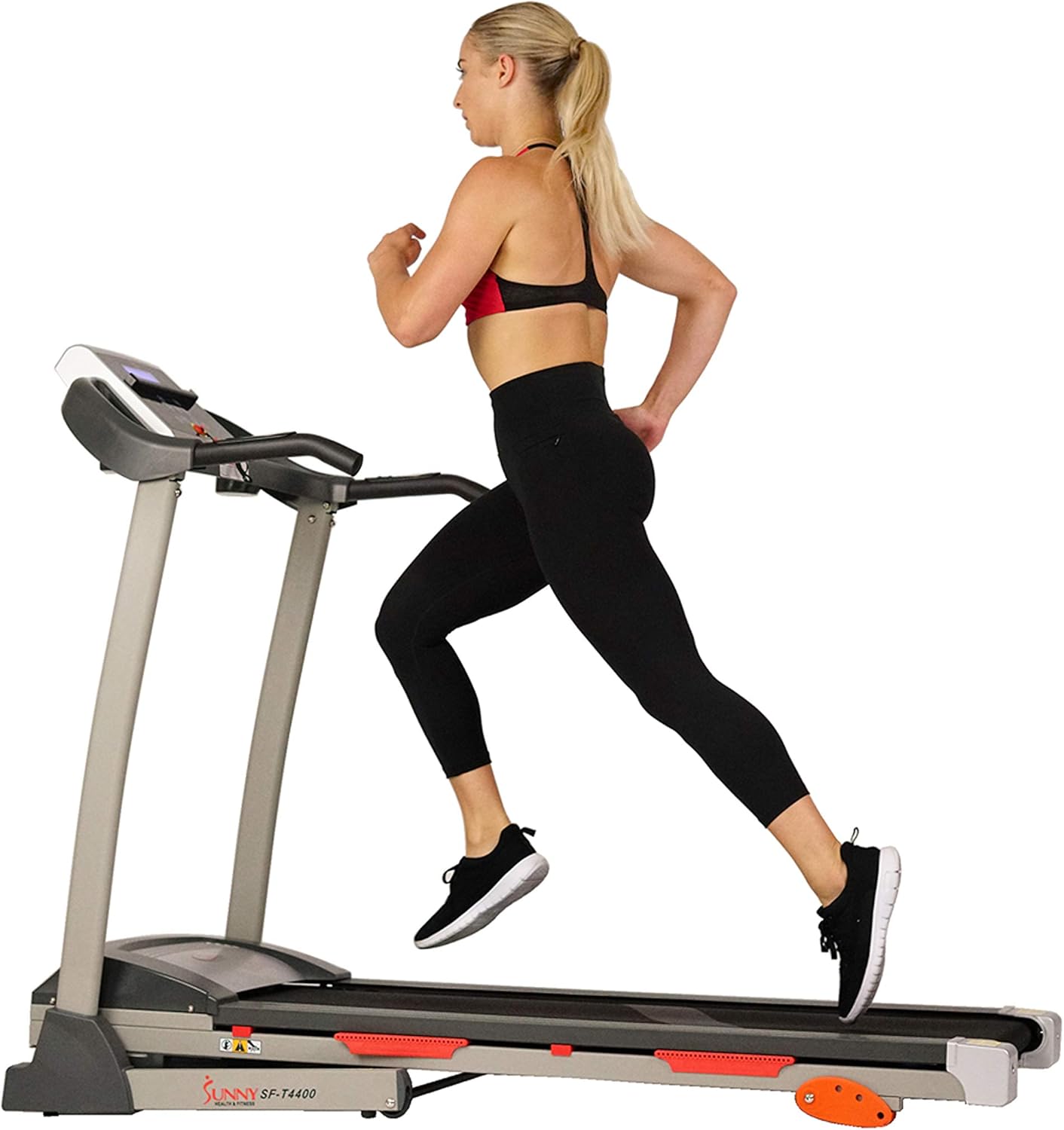
Sunny Health & Fitness Walking Treadmill
Designed specifically for walking — not running. Lower max speed, wider belt, and long handrails provide extra safety for seniors. The low step-up height makes getting on and off easy.

Exerpeutic 400LB Walking Treadmill
Extended handrails run the full length of the treadmill — the safest design for seniors with balance concerns. Walking-friendly speed range with a 400 lb weight capacity. Heart rate sensors in the handles. Wide deck for a secure feel.

Schwinn 270 Recumbent Bike
Our top pick for seniors — the recumbent seating position is easy on the back and knees. 25 resistance levels, Bluetooth connectivity, and a comfortable ventilated seat with lumbar support. Quiet and smooth.
Pros
- Easy on back and knees
- 25 resistance levels
- Comfortable lumbar support
Cons
- Large footprint — needs dedicated space
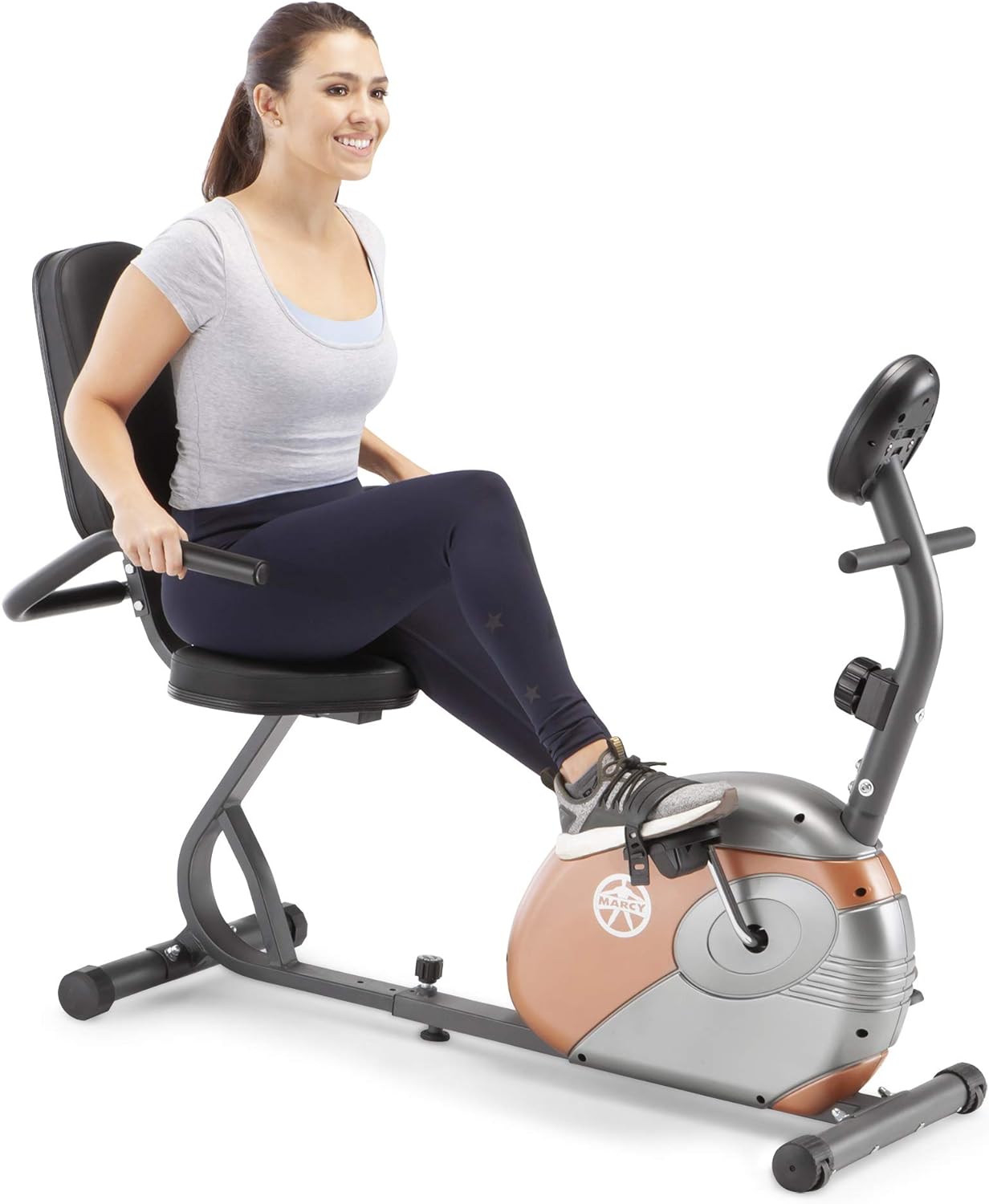
Marcy Recumbent Exercise Bike
An affordable recumbent bike with 8 resistance levels and a simple LCD display. The step-through frame design makes it easy to get on and off. Compact footprint.

Exerpeutic 900 Recumbent Bike
Magnetic tension system with 8 resistance levels lets you progress at your own pace. Large cushioned seat with lumbar support adjusts to accommodate users from 5'2" to 6'3". Extended leg stabilizers prevent wobbling during use. 300 lb weight capacity and built-in heart-rate sensors.

Schwinn 430 Elliptical Machine
Full-body, low-impact workout that's gentle on knees and hips. 20 resistance levels, moving handlebars for upper body, and a smooth, natural stride. The high-speed inertia drive system keeps motion fluid.

Sunny Health & Fitness Elliptical Cross Trainer
A budget-friendly magnetic elliptical with a smooth, quiet stride. Digital monitor tracks time, speed, distance, and calories. Compact enough for small spaces.
Buying Guide
Final Editorial Verdict
The Schwinn 270 Recumbent Bike is our top pick for most seniors — comfortable recumbent seating, smooth resistance, and a large display. For strength training, the Total Gym XLS is gentle on joints with over 80 exercises. The Sunny Health Walking Treadmill is the safest option for walking exercise at home.